
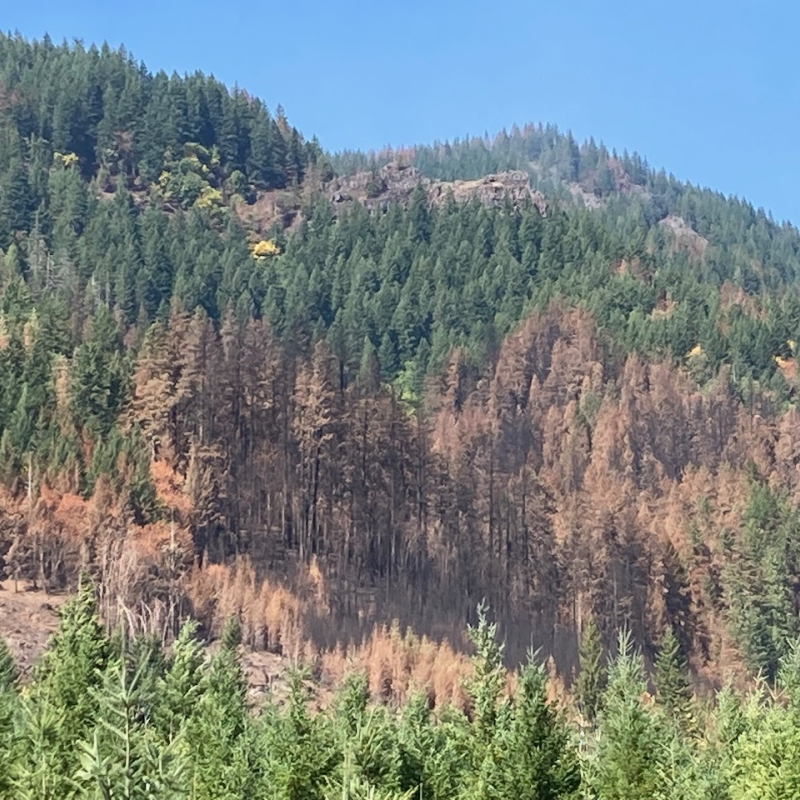
Mixed severity fire has played an important role in the ecology of the H.J. Andrews Experimental Forest (HJA) and surrounding areas for at least the 500-700-year history that we can reconstruct from tree rings and other records. Fires, and patches within individual fires, have ranged in intensity from low-severity understory fires that killed few adult trees, to stand-replacing fires that killed most or all of trees in the stand. All of the HJA has had at least one fire within the last 500 years (the approximate age of many of our old growth trees), and many stands show evidence of one or more additional fires within the last 200 years that were large enough to result in a new cohort of Douglas fir trees. In the last 80 years, fire starts have been fairly common (ca. one every other year) but fires had been controlled at well under a half hectare in size, until 2020. The Holiday Farm fire, in 2020, burned 2.3% of the Lookout Creek watershed at mixed severity, mainly in Watersheds 1 and 2 (and WS9, which is outside the Lookout Creek drainage and not included in that total). The Lookout Fire, in 2023, impacted 67.4% of the HJA with a wide range of fire severity, including high severity areas that left charred trees, to low severity areas that burned the understory and left overstory trees alive. Researchers are leaning into the decades worth of pre-fire data from our long-term ecological research program to understand how the post-fire landscape is changing and what mechanisms are driving those changes.