

164
bird species found on the Andrews Forest
The Andrews Forest is home to resident birds, such as the Varied Thrush and the the iconic Northern Spotted Owl, which stay all year round. The Forest is also home to migratory birds, such as the Black-Throated Grey Warbler and the Western Tanager (pictured here), which spend the summer breeding season at the Andrews Forest and fly south for the summer. The full list of birds can be found on our Species List.

505
plant species found on the Andrews Forest
Plant species at the H.J. Andrews Experimental Forest include enormous Douglas fir trees, which can reach 300 feet tall, and the tiniest mosses. The 505 species recorded include plants with flowers, cones, catkins, and fruits. The full list of plants species can be found on our Species Lists page.

25%
of the Andrews Forest area harvested for timber
The first timber harvest at the H.J. Andrews Experimental Forest (then the Blue River Experimental Forest) occurred in 1951 to study the effects of logging on hydrology, sediment yield, and nutrient losses. Later harvests were done to test different harvesting techniques. Learn more about the history of the Forest on our History page.

306
feet, the tallest tree at the Andrews Forest
The tallest tree on the Andrews Forest, a Douglas Fir, was identified by LIDAR imaging. If you saw the previous version of this Fast Fact, you would have seen that the tallest tree on site was 299 feet, measured in 2008. The height of that tree was verified in 2009 with a measuring tape! This other, now taller tree, was measured by LIDAR in 2016. A cross-section of that LIDAR image is pictured here. As a point of comparison, the Statue of Liberty stands at 305 feet tall, including her base.

30
gigabases, genome size
Salamanders have extraordinarily large genomes! While the genomes of most vertebrate species (like humans and deer) are around 3 gigabases (gb), salamander genomes are orders of magnitude larger! For example, the rough-skinned newt (Taricha granulosa) has a genome size of approximately 30 gb!! That's 10x the genome size of the deer the newt shares the HJA with!

2.2
seconds, Lookout Creek's average water discharge is equivalent to one concrete truck every 2.2 seconds
Lookout Creek’s average discharge is the equivalent of a fully-loaded concrete truck rumbling down the river bed every 2.2 seconds!
Lookout Ck mean annual discharge - 121.83 cubic feet per second (cfs)
A standard concrete truck holds 10 cubic yards or 270 cubic feet (cf).
270 cf ÷ 121.83 cfs = 2.21 s
Concrete trucks appear to be 7.168 m long (google) and if you chained them, bumper to bumper with no space in between, the “train of concrete trucks” would be traveling 7.25 mph.
With a more reasonable following distance of a couple of truck lengths, you’d have a never ending line of concrete trucks moving around 25 miles an hour!

20
species of reptiles and amphibians found at the Andrews Forest
Twenty different species of reptiles (which include lizards) and amphibians (which include salamanders) can be found at the Andrews Forest. The rough-skinned newt (Taricha granulosa) is so commonplace at the Forest that it has taken on the role of mascot, appearing in the Andrews Forest logo.
The Coastal Giant Salamander (Dicamptodon tenebrosus), fondly nicknamed Dicamp by researchers, can reach up to 12 inches (30 cm) long. The Dicamp is subject of an ongoing study, 35+ years running, that tracks the size and locations of salamanders and trout in a stream reach of Mack Creek at the HJA. Researchers have found that the average size of adult trout has gotten smaller over the decades-long study, while salamanders in the same stream reach are not changing in size, indicating that salamanders may be more resilient to changes over time.

15,800
total acres in the drainage basin of Lookout Creek
The Andrews Forest is situated in the western Cascade Range of Oregon, and covers the entire 15,800-acre (6400-ha) drainage basin of Lookout Creek.
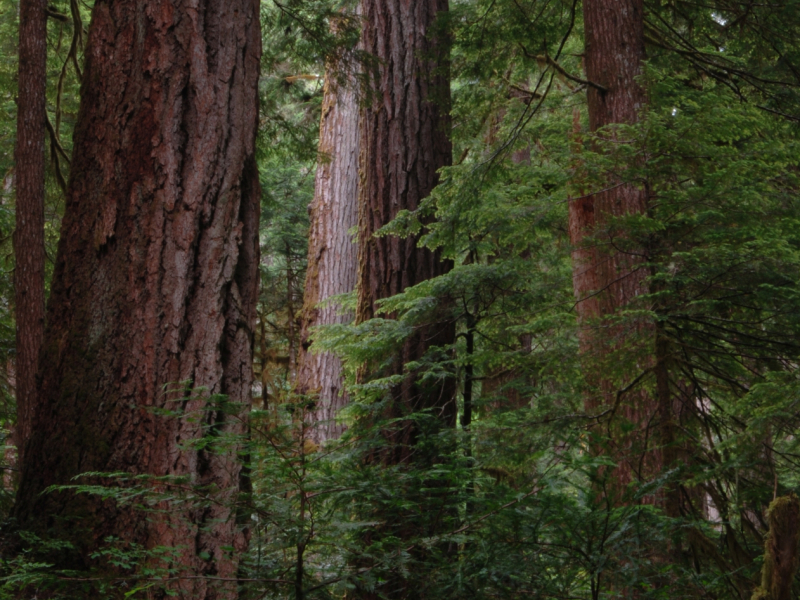
40%
old-growth trees covering total areas
Prior to recent fires, we estimated that 40% of the H.J. Andrews Experimental Forest was covered in old growth forest, characterized by 400-500-year-old canopy emergent Douglas fir and complex vertical structure. Recent fires since 2020 have burned ca. 70% of the landscape and altered the structure and successional trajectory of many of our forest stands, including in some of our largest remaining unroaded old growth areas. Whether this recent disturbance constitutes a loss of old growth area depends on the burn severity and the eye of the beholder. We are studying the effects of the changes in old growth and mature stands from multiple perspectives, including the most important ones, those of old growth associated species.

9
species of fish found at the Andrews Forest
The nine species of fish found at the Andrews Forest live in the small, cold streams that flow through the forest. The species include the cutthroat trout, the mottled sculpin, and the speckled dace. To learn more about the kinds of fish and other creatures at the Andrews Forest, see our Species Lists page.

5,340
feet, maximum elevation in the forest
Elevation of the H.J. Andrews Experimental Forest (HJA) ranges from 1,350 to 5,340 feet (410 to 1630 m) above sea level. Some of the high elevation areas of the HJA are meadows. See the Forest Description for more information.

1951
date of first timber harvest
The first timber harvest at the Andrews Forest occurred in 1951. Scientists initiated three sets of experimental watersheds designed to study the effects of logging on hydrology, sediment yield, and nutrient losses. Treatments included clearcutting and partial cutting, and one watershed was left in its “natural” forested condition as a control. Learn more about the history of the Forest on our History page.

3,100+
invertebrate species found in the forest
Invertebrates, which include insects, spiders, centipedes, and slugs, number more than 3,100 at the Andrews Forest, with the possibility of many more species to be found and documented. See our species lists for a full list of the invertebrate species that have been documented...so far.

54
species of mammals found at the Andrews Forest
The fifty four species of mammals recorded at the H.J. Andrews Forest include black bear, flying squirrel, spotted skunk, and red tree voles. New techniques such as DNA metabarcoding allow researchers to detect species that may elude more traditional methods of sampling. DNA metabarcoding of animal scat allows researchers to use animals to sample the other animals in the forest. For example, researchers can sample fox scat and detect DNA of the species of mammals in the fox's diet. This allows researchers to detect animals like red tree voles and white-footed voles. To learn more about what animals live at the forest, see our Species List page.
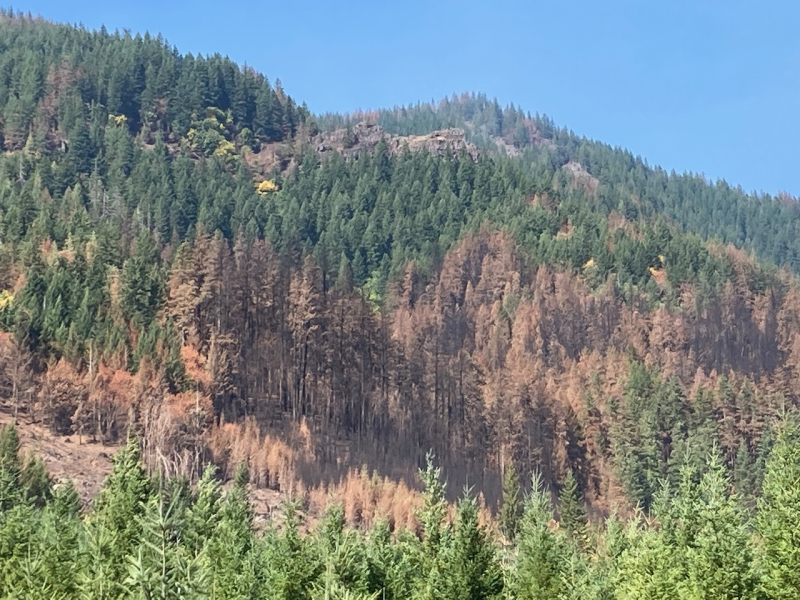
70
percent of the HJA burned since 2020
Mixed severity fire has played an important role in the ecology of the H.J. Andrews Experimental Forest (HJA) and surrounding areas for at least the 500-700-year history that we can reconstruct from tree rings and other records. Fires, and patches within individual fires, have ranged in intensity from low-severity understory fires that killed few adult trees, to stand-replacing fires that killed most or all of trees in the stand. All of the HJA has had at least one fire within the last 500 years (the approximate age of many of our old growth trees), and many stands show evidence of one or more additional fires within the last 200 years that were large enough to result in a new cohort of Douglas fir trees. In the last 80 years, fire starts have been fairly common (ca. one every other year) but fires had been controlled at well under a half hectare in size, until 2020. The Holiday Farm fire, in 2020, burned 2.3% of the Lookout Creek watershed at mixed severity, mainly in Watersheds 1 and 2 (and WS9, which is outside the Lookout Creek drainage and not included in that total). The Lookout Fire, in 2023, impacted 67.4% of the HJA with a wide range of fire severity, including high severity areas that left charred trees, to low severity areas that burned the understory and left overstory trees alive. Researchers are leaning into the decades worth of pre-fire data from our long-term ecological research program to understand how the post-fire landscape is changing and what mechanisms are driving those changes.

-11
degrees Fahrenheit, coldest temperature recorded
The lowest temperature recorded at the Andrews Forest was -11 Fahrenheit (-24 degrees celsius), taken at the VANMET meterological station. Climate measurements, including temperature, rainfall, and windspeed, have been recorded at the Andrews Forest for decades, allowing scientists to watch for trends and make comparisions over time. Learn more about our climate research on our Research Programs page or find out more about locations and instruments on our Climate Stations page.

14
feet, largest snowpack recorded at the Andrews Forest
The largest snowpack recorded at the Andrews Forest was 4.4 meters (or 14 feet), at the Upper Lookout Meterological Station in 2008. The water storage in the snowpack on this date was equal to a depth of 1.56 meters (or 5 feet) of liquid water. Learn more about our climate measurements on our Research Programs page.
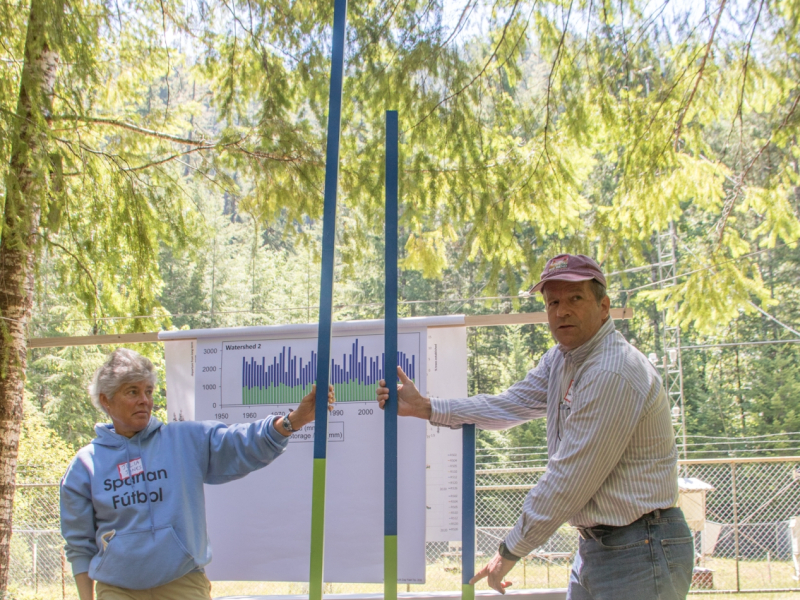
7
feet, average annual rainfall
The amount of rain that falls at the Andrews Forest over a whole year is 7 feet (2.1 meters). That's 3 inches (7.5 centimeters) more than the height of LeBron James, the basketball player!

8
inches long
During our 2025 annual sampling of fish and salamanders in Mack Creek, we encountered a remarkable survivor: the largest trout we captured that year, measuring 213 mm total length (over 8 inches). We first PIT-tagged this fish in 2021 in the second-growth reach below the gauge station, when it was only 100 mm long. Over the following years we recaptured the same fish repeatedly as it moved through the lower, middle, and upper sections of the reach in 2022, 2024, and 2025. Now, likely 5–6 years old, this trout has persisted through the years—and the Lookout Fire—making it a proof of resilience in Mack Creek.

4251
flower visits
4251 honeybee and bumblebee flower visits, per hour, per hectare of meadow at the HJA
Habitat loss, climate change, pathogens, and invasive species have reduced pollinators globally. Since 2011, the Andrews Forest pollinator study has surveyed flowering plants and all flower-visitors in montane meadows, yielding one of the longest continuous plant–pollinator interaction datasets worldwide. The meadows are shrinking habitat islands, reduced by tree invasion to <2.5% of the Andrews Forest area. The meadows are biodiversity hotspots, with >189 flowering plant species and diverse native bumble bees and solitary bees. The long-term meadow study provides a rare opportunity to test how plant-pollinator interactions respond to environmental change.

61
meters up in a tree, a clouded salamander
Clouded salamanders (Aneides ferreus), despite being terrestrial and spending most of their lives on the forest floors, are also semi arboreal. Researchers James Swingle and Eric Forsman found that clouded salamanders were sharing nests with tree voles, high up in the tree canopy. The researchers hypothesized that this could be a beneficial relationship, where the salamanders eat the mites and other invertebrates in the vole nests, which can be problems for the tree voles in large quantities. The highest tree vole nest with a clouded salamander found was at 61 meters, or 200 feet.

1600
macrofungi
To date, 1,600 macrofungi—which are fungi with visible fruiting bodies, like mushrooms—have been identified and cataloged at the H.J. Andrews Experimental Forest (HJA). Researchers use visual identification of sporocarps paired with DNA markers to make positive identifications. Fungi play a vital role in the forest ecosystem, as decomposers, mycorrhizal associates, pathogens, and anchors of soil. Research after two fires at the HJA show that overall species richness was higher in the unburned old growth forest, but some fungi, called Pyrophilous, are favored by fire, both fruiting more readily and increasing in abundance in the soil in burned areas.
Photo: this distinctive macrofungus, Astraeus pteridus, can be found on the forest floor following a wildfire.

110
degrees Fahrenheit, hottest temperature recorded
The highest temperature recorded at the Andrews Forest is 110.3 Fahrenheit (43.5 degrees Celsius), taken at a fan-aspirated shield at the PRIMET meteorological station on June 28, 2021. Meteorological measurements, including temperature, rainfall, and windspeed, have been recorded at the H.J. Andrews Experimental Forest for decades, allowing scientists to watch for trends and make comparisons over time. Learn more about our research on our Research Programs page or find out more about locations and instruments on our Climate Stations page.

1000
years before a western red cedar log will have decomposed
Scientists estimate that it will take 1,000 years before a western red cedar log in the long-term decomposition experiment will have completely decomposed. Compare that to the estimate of how long a pacific silver fir log will take -- only 57 years! The difference in decomposition time between the two different species of trees is due to the structure of the wood, the chemistry of the wood, and the kinds of microbes that decompose the wood over time. Decomposition time of wood influences carbon storage and soil. Learn more through our publications and through our research programs page.

4192
kilometers
The maximum distance migrated by a Hermit Warbler from its breeding grounds in the H.J. Andrews Experimental Forest to its wintering grounds in Chiapas, Mexico, according to geolocator work conducted at the HJ Andrews. Read the publication: "Annual migratory movement, apparent molt-migration, migration schedule, and diffuse migratory connectivity of Hermit Warblers"