
Our research projects, each an integration of long-term, short-term, and modeling approaches, are described below. We study biodiversity, canopy ecology, carbon and nutrient dynamics, climate, conservation ethics, disturbance, hydrology, information management, social science, soils, stream ecology, and vegetation dynamics. Additional areas include arts and humanities, LTER cross-site, and regional research. The 2023 Lookout Fire further emphasized the extraordinary value of long-term data to address pressing issues of relevance to science and society.

Biodiversity, Community, and Population Ecology
The forests, streams, and meadows of the H.J. Andrews Experimental Forest contain thousands of species of insects, 83 bird species, 19 gymnosperm (conifer) species, 53 mammal species, 9 species of fish, and a host of other taxa (see our species lists). Biodiversity research at the HJA examines the causes and consequences of biological diversity in our landscape. This includes drivers of long-term population dynamics in plants, fish, salamanders, mammals and birds. We seek to understand how land use, natural disturbance, and climate affects these patterns and relationships. Studies range from the genetic to landscape scales, and include field observational studies, experiments, and modeling.

Stream Ecology
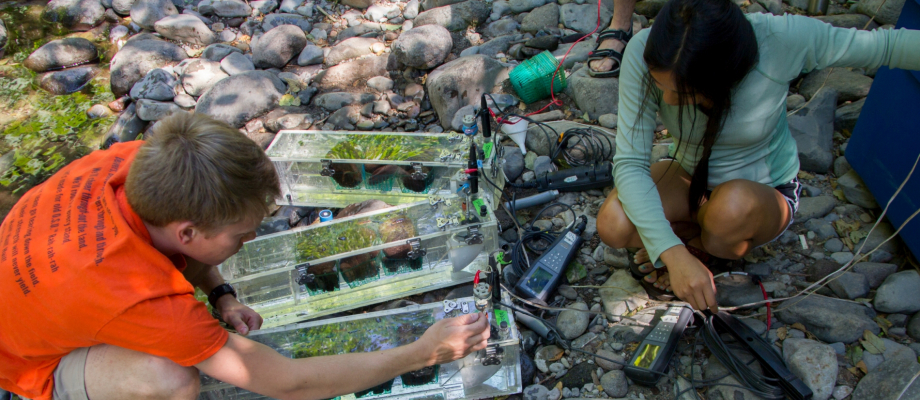
Stream ecology research has been designed to explore long-term processes that shape aquatic ecosystems, identify critical links between forests and streams, and examine the influences of natural and anthropogenic disturbances on stream communities and processes. Research includes long- term population dynamics and community interactions for vertebrates (fish and salamanders) and invertebrates (insects), geomorphic and hydrologic processes, riparian dynamics, nutrient retention and fluxes, and drivers of stream temperature from reach to landscapes.

Carbon and Nutrient Dynamics
The ways that carbon and other nutrients move through a forest are influenced by the interaction of many parts of the ecosystem. As such, carbon and nutrients provide a way to examine ecosystem function and response to environmental change. Work in this component seeks to measure rates of production, decomposition, nutrient cycling, and the formation of soil organic matter and to determine the factors controlling spatial and temporal variation in these processes. In addition, the stores of carbon and nutrients involved in these processes and cycles are being measured. Simulation modeling, coupled with remote sensing, are being used to extrapolate results to the Pacific Northwest region.

Climate
The combination of mild temperatures, wet winters, and dry summers that characterize the climate of the Pacific Northwest strongly influences many ecological and geophysical characteristics of the region. Long-term measurements of air temperature, precipitation, snow, soil temperature, humidity, and other variables have been collected at multiple sites since the 1950s. These data are used in maps, models, and analyses of temporal patterns and trends to characterize and understand the dynamic climate of the site and the region. Major areas of research focus on the interactions of regional climate with topography, cold-air pooling, snowpack accumulation and melt patterns, and temporal trends in air temperature, precipitation, and snow. See our Climate Stations description page for more information on location and instrumentation.

Conservation Ethics
Natural resource management can be seen as a set of practices, which reflect certain ideas about the world. Ideally management practices will be consistent with our best scientific ideas about the workings of both biophysical and social systems, but management practices also and inevitably manifest our ideas about what is good, what is right, and what is valuable. For example, we manage riparian zones in certain ways because we understand certain relationships between riparian zones and streams and rivers; but also because we believe certain management practices will achieve important goals, or protect important values, related to streams and rivers. In this way, management fuses science and ethics.

Disturbance
Forest and stream ecosystems undergo progressive, slow change by processes such as succession and soil development. Abrupt changes are induced by disturbances such as fires, floods, wind, landslides, timber harvests, road building, insects, and volcanic activity. The interplay of disturbances and succession drive ecosystem dynamics. We study the past and present frequency, severity, duration, and spatial pattern of natural and management disturbance processes that dominate the disturbance regimes of the H.J. Andrews Experimental Forest and other parts of the Pacific Northwest. We also study effects of disturbances on biota and on ecological and watershed processes.

Hydrology
Water stores and flows in the HJA are controlled by, and shape, the topography, climate, and vegetation in the landscape, while also affecting human uses of streams, rivers, and water resources. The hydrology of the site is representative of the steep forested ecosystems of much of the Pacific Northwest Cascade mountains. The hydrologic setting of this region includes a mild climate with wet winters and dry summers; massive, conifer, evergreen forests with high leaf area that can intercept, store, and transpire large quantities of water; thin soils on steep, highly weathered hillslopes which facilitate rapid water flux from slopes to channels; and transient snowpacks that can contribute to extreme regional floods. Water flows from the HJA influence downstream communities including the cities of Eugene, Salem, and Portland. Our program has a long history of research using experimental watersheds, tracer and water dating studies, process and ecophysiological studies, analyses of soil hydrologic properties, and other approaches. See our Experimental Watersheds and Gaging Stations page for more information about gages and experimental watersheds.

Information Management
Information Management plays a major role at the HJ Andrews Experimental Forest Long-Term Ecological Research (LTER) site. Intensive research, conducted since the 1950s, has resulted in many diverse, long-term ecological databases and a strong commitment to information management. Hundreds of ecological databases are managed through the Forest Science Data Bank (FSDB), which has long been an essential component of the Andrews Forest LTER and is jointly sponsored by the OSU College of Forestry and the US Forest Service PNW. The FSDB is managed through an information management system that supports the collection, quality control, archival and long-term accessibility of collected data and associated metadata.
The Andrews Forest LTER maintains an extensive bibliography and image library, and personnel and keyword databases. The site is also active in other LTER network projects. See the Information Management page for more information.

Social Science
Science at the H.J. Andrews Experimental Forest has long played an influential role in federal forest management and in public and policymaker perceptions of forest ecosystems, old growth, watershed processes, microclimates, road hydrology, and the role of dead wood in forests and streams. We seek to identify social processes that explain the changing relationship of science to federal forest policymaking, and evaluate the potential for an adaptive governance system characterized by tight connections and feedbacks between scientific discovery and forest management. Past research has included analyses of public perceptions of LTER science, barriers to adaptive management, and the social acceptability of alternative silvicultural practices associated with ecosystem-based management.

Soils
Work on soils in the HJ Andrews Experimental Forest began with a soil survey conducted in 1962 by Forest Service scientists. Early work on soil characterization focused largely on hydrologic properties. More recent studies concentrated on carbon storage in soils supporting tree stands of different ages, root decomposition, and nitrogen fixation. Both early and recent studies examined effects of forest harvest practices on soil erosion. The DIRT (Detrital Input, Removal, and Trenching) experiment tests questions on how soil carbon is stabilized and destabilized by manipulating aboveground litter input, fine root input, addition of woody detritus, and removal of the A horizon. Ongoing studies have examined pyrogenic carbon, the movement of carbon and nitrogen in soils, and how soil properties control the release of nitrogen following timber harvest.
Canopy Ecology and Microclimates
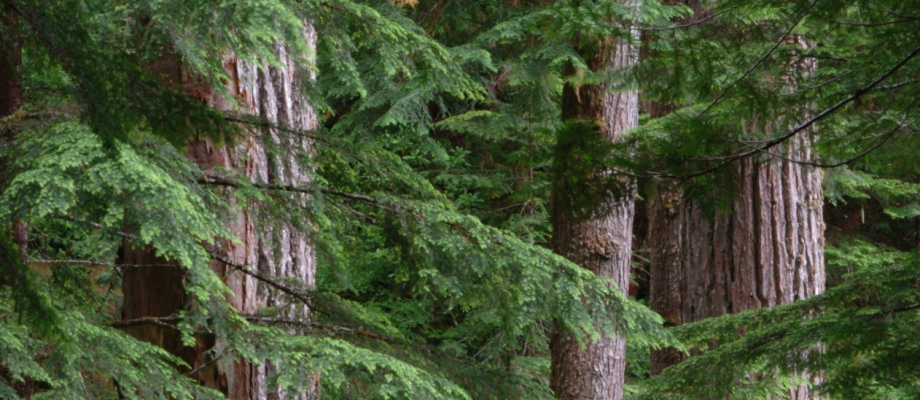
The upper canopy of forests is known to experience a very different microclimate than the rest of the forest: it is often simultaneously brighter, hotter, windier, and drier. The upper canopy also contains most of the leaf area; because it absorbs most of the solar radiation, it accounts for the great majority of carbon and water exchanges in most forests. Critically, this is also the zone where most climate variations and stress likely manifest. We seek to understand whether and how the forest canopy and the understory below are affected by broader-scale climate processes such as heat, drought, and wildfires. This research has critical relevance to tree growth and survival as well as wildfire risk. We also aim to understand how canopy microclimate observations can advance fundamental biological understanding of canopy processes and properties and their linkages to atmospheric and sub-canopy dynamics. This includes work on tree physiology (via climbing into the canopy to collect data), to understand how water availability contributes to physiological thermotolerance and post-stress recovery. Our project also utilizes high-resolution dendrometry and canopy microclimate data to understand how climate extremes like the 2021 Heat Dome affect tree stress and growth. This research will help inform predictions of canopy responses to future extreme heat and drought events.

Vegetation Dynamics
Understanding the role of vegetation dynamics in forest ecosystems of the Pacific Northwest is a fundamental part of long-term ecological research at H.J. Andrews Experimental Forest. We seek to understand how plant communities change in composition and structure over time and what processes control these changes. We are particularly interested in how changes in vegetation affect water-use, carbon storage, nitrogen cycling, and disturbance regimes, as well as how disturbance (such as fire) will influence the future composition and structure of forests. Vegetation research uses data from a large network of permanent study plots across a wide range of stand ages, habitats, management histories, and disturbance types in Oregon and Washington and data from long-term monitoring of experimental watersheds at the H.J. Andrews Experimental Forest. The long-term data from the permanent study plot program provides the only means of directly observing the relatively slow dynamics of Pacific Northwest forests .

Arts and Humanities
Our long-standing engagement of the arts and humanities does not fit neatly into any one category of activity. It is in part a form of basic inquiry (paralleling basic science), in part science journalism and public outreach, and in part an education effort. In the words of the mission statement of the Spring Creek Project for Ideas, Nature, and the Written Word, our arts/humanities collaborators, we wish to: "bring together the practical wisdom of the environmental sciences, the clarity of philosophical analysis, and the creative, expressive power of the written word, to find new ways to understand and re-imagine our relation to the natural world." Learn more on our Arts and Humanities page.
LTER Cross-Site Research
Researchers at the Andrews Forest LTER are actively involved, both leading and participating in many cross-site projects. Many of the cross- site collaborations involve scientists from USFS Experimental Forests, biological field stations and other sites of long term research. The LTER Network creates scientific, social and administrative opportunities for cross site collaborations through funding for workshops and meetings.