

In a recent essay in Nature, former Lead PI of the LTER program, Michael Paul Nelson, draws on lessons long familiar in the humanities. Nelson argues that we should shift our priorities toward…

Growing evidence has shown that changes in landscape-level factors by accelerated land-use change can shape soil pathogenic fungal diversity. Researchers assessed how pathogenic fungal diversity in…

In late June 2021, multiple days of record-breaking heat caused an unprecedented amount of foliage death in the forests of the Pacific Northwest. Portions of tree canopies with healthy green foliage…

Understanding the mechanisms that enable species to coexist is essential for explaining community structure and biodiversity. Researchers compared the diets of two dominant stream predators in western…

Using data compiled from around the world and over decades, researchers showed that large wood mobility in rivers is infrequent and highly variable, influenced by a combination of wood characteristics…

Forest plantations are widespread globally. Young forest plantations (hereafter young forests) differ from natural old-growth forests (hereafter old forests) in above- and below-ground structures…

Forest succession theory predicts long-term dynamics of tree species and ecosystem biomass through time, with shifts from early- to late seral species and cessation of live biomass accumulation being…

OSU graduate student, Matthew Weldy, is harnessing the power of AI and open-source modeling to process millions of hours of recorded acoustic data of birds across the forests of the Pacific Northwest…

The 200-year log decomposition study, now entering year 40, is already yielding unexpected insights. Read the full story in the September 2025 issue of Scientific American magazine: https://www…

“People say, ‘Oh the forest was lost.’ It’s not lost. It’s changed,” said Mark Harmon, a forest decomposition expert and professor emeritus at Oregon State University. Half of his research plots at…

Researchers studied the impact of experimentally reduced streamflow and increased temperature on fish and salamander. Results suggest that future shifts in community dynamics may favor trout under…

Watersheds and streams, such as this one at the H.J. Andrews Experimental Forest, are impacted by disturbances such as fire and reduced snowpack. Photo by Ben Nash.

Residual canopy cover provides buffering of near-surface temperatures, but benefits are limited under extreme conditions In response to recent extreme heat events, such as the 2021 heat dome over the…

Wildfires are increasingly affecting the wet forests of the Pacific Northwest, a trend expected to intensify with climate change. These fires disrupt water quality and streamflow, threatening aquatic…
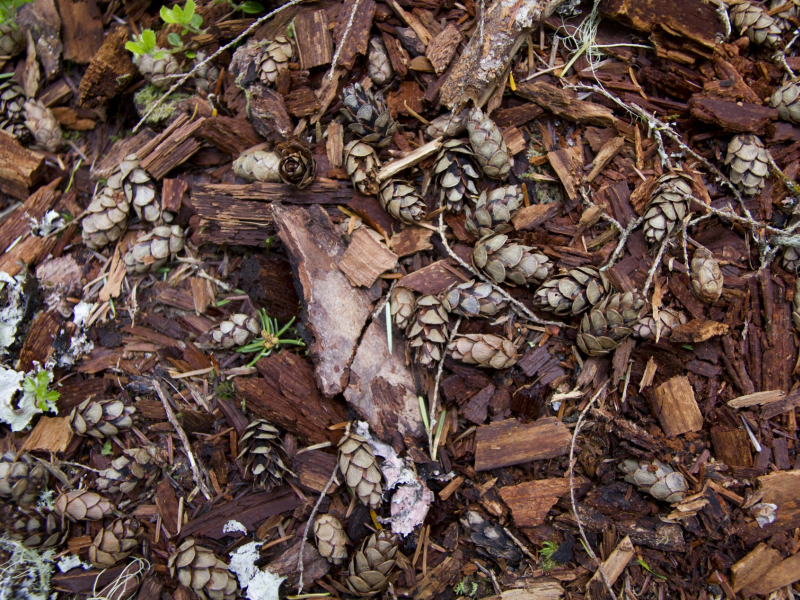
An LTER synthesis working group effort brought together long-term datasets on woody plant reproduction to investigate drivers and patterns of seed masting (synchronous seed production across years) in…
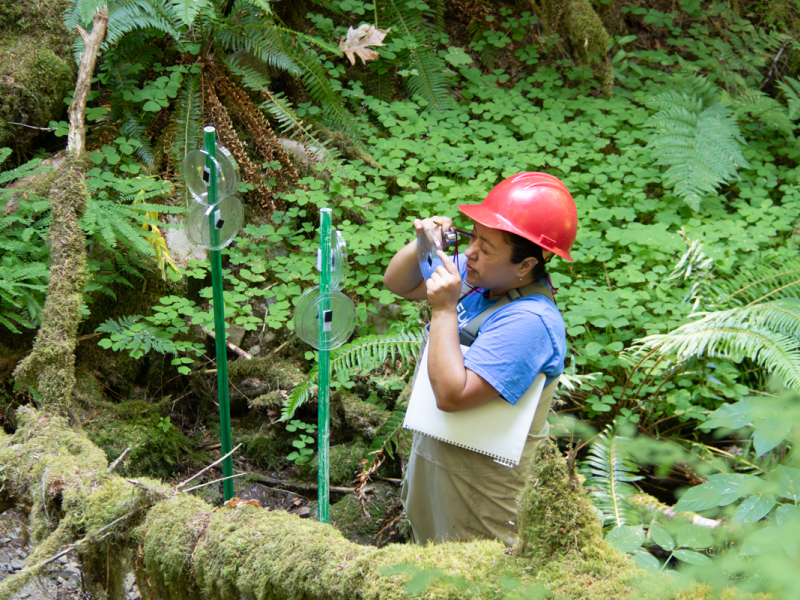
Andrews Forest graduate students and their work are featured in the Winter 2025 issue of the National Widlife Magazine, in an article written by Marina Richie, titled, “ Undaunted, Grad Students…
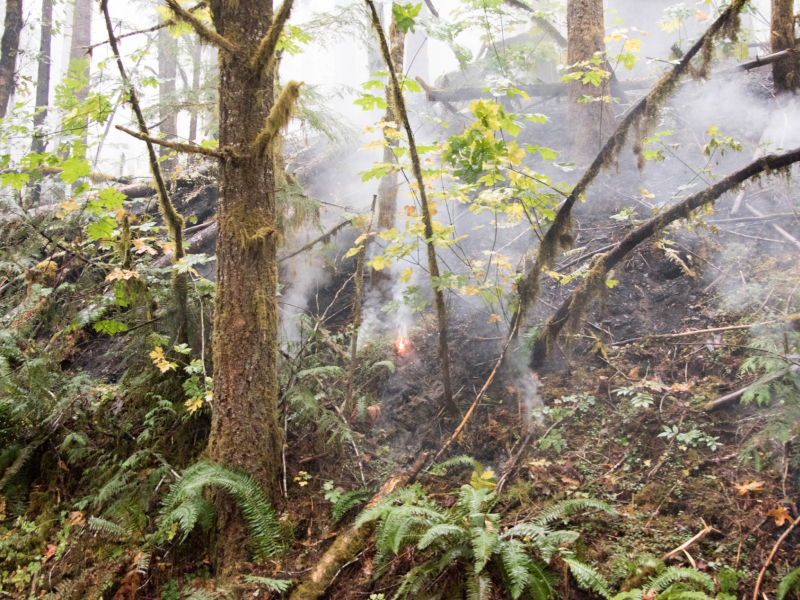
Scientists studied the impacts of the 2020 Holiday Farm Fire at the HJ Andrews Experimental Forest, where rare pre-fire stream discharge and chemistry data allowed them to evaluate the influence of…

A compressed breeding schedule and departure of Hermit Warblers from their breeding grounds in early July may indicate that breeding is limited by a short window of favorable climatic conditions…

To fill a key knowledge gap of the western spotted skunk (Spilogale gracilis), researchers used camera traps and models to learn about skunk home ranges and movements

In the last 10 years, David Herasimtschuk has photographed forests across the Pacific Northwest, documenting the inhabitants of these last remaining old-growth ecosystems. From salamanders and salmon…

In September 2020, the Holiday Farm Fire, driven by fierce east winds, burned 173,000 acres along the forested McKenzie River valley in Oregon. The "Following Fire" project weaves a complex story of…

Virtually all ecosystem and ecological processes are being affected by changing climate. Ecosystem responses differ by region or ecosystem type, and interact with other past and ongoing human…

Researchers detailed how wind, vegetation structure (e.g., canopy height, the age of trees, etc.), and site topography played a significant role in burn severity patterns of five megafires that burned…

Some species of birds, including the Hermit Warbler, may find more favorable habitat conditions in the buffered microclimate of old-growth forests. Photos by Hankyu Kim.

The channel source hypothesis adds a potential mechanism to explain dissolved organic carbon dynamics observed in streams during storms.

Regional models project declining dry-season relative humidity in the future. Collectively, these findings indicate that future climate conditions will increase vertical and downslope moisture loss…

For decades, researchers have been revisiting the same forests, and the same trees, tracking tree growth and mortality. The long-term data enable scientists to answer complex questions about how…

For aquatic insects, a major life-cycle event is emergence, the transition of the aquatic juvenile stage to a terrestrial flying adult. If aquatic insects experience warmer water, do they emerge…

Pre-fire conditions and burn severity are strong predictors of vegetation response to fire, and distinct differences in the species composition of young and old stands can lead to very different post…

A snow drought occurs when warm temperatures result in mountains receiving a higher proportion of precipitation as rain instead of snow.

Soil is the largest store of carbon (C) in the terrestrial biosphere, containing more than twice as much C as the atmosphere. Hence, even small changes in soil C may have a relatively large effect on…

A summary of work examines the current state of knowledge regarding how dead trees have, and will, influence water, nutrient and organic matter flows within and between ecosystems to influence very…

Thanks to the efforts of Kari O’Connell, the Andrews Forest has played a leadership role in establishing the Undergraduate Field Experiences Research Network (UFERN). This network brings together…

Old-growth forests, such as those found within the HJ Andrews Experimental Forest Long-Term Ecological Research site, may offer temperature refugia for animals in a warming climate.

"The Rapid Rise of Next-Generation Natural History,” outlines the renaissance of natural history with modern technological and statistical tools. Camera-traps and acoustic recorders, aircraft- and…

Food webs show the architecture of trophic relationships, revealing the biodiversity and species interactions in an ecosystem. At the H.J. Andrews Experimental Forest, researchers found that…